↓ Scroll ↓
Apr 5, 2026
Discover the best facial for sensitive skin. Our guide covers gentle techniques, safe organic ingredients, and essential tips for a calming treatment.

You book a facial because your skin feels tight, flushed, or unpredictable. You want comfort. Instead, you may have left other treatment rooms with more redness than radiance, a shelf of half-used products, and a growing suspicion that “sensitive skin” is just another way of saying your skin cannot tolerate anything.
That frustration is real. Sensitive skin often creates a cycle of hesitation. A treatment sounds promising, the ingredients seem elegant, the language on the menu feels soothing, and then your face tells a different story by evening. Burning, stinging, heat, itching, or that unmistakable feeling that your skin is suddenly over-alert.
The good news is that sensitivity is not rare, strange, or a personal failure to find the “right” product. Approximately 60 to 70% of women and 50 to 60% of men globally report some degree of sensitive skin, and in the United States prevalence is 44.60%, according to a review in Frontiers in Medicine (frontiersin.org). Many people are searching for the best facial for sensitive skin because the face is where sensitivity shows up most quickly and most visibly.
A beautiful facial for reactive skin is not about doing more. It is about doing less, better. It is guided by restraint, precision, and respect for the barrier.
Understanding this empowers a discerning client. Once you understand what makes a facial safe, what ingredients create peace instead of chaos, and which technologies can support calm without provoking the skin, the search becomes much easier. You stop shopping by trend. You start evaluating by principles.
Embarking on Your Journey to Calm Radiant Skin
One of the most common stories in treatment rooms is also one of the quietest. A client sits down and says, “I never know what my skin will do.” She may describe a cleanser that felt fine for three days and then suddenly started stinging. He may mention that every “glow” treatment seems to leave lingering heat across the cheeks. Often, both have tried to be diligent. They have spent time and money. They have read labels. They have still ended up confused.
That uncertainty can make self-care feel stressful instead of restorative.
When hope and reaction keep trading places
Sensitive skin rarely behaves in a linear way. It can seem calm in the morning and reactive by evening. It can dislike heat one week and overreact to friction the next. Because of that, many people start assuming facials are not for them.
That is rarely the full truth.
The better question is not whether facials are safe for sensitive skin. The better question is which facial, performed in what manner, with what level of customization.
A proper facial for reactive skin should feel like a reset for the nervous system of the face. It should reduce the urge to chase stronger treatments. It should leave the skin feeling cushioned, settled, and comfortably hydrated.
Knowledge changes the experience
Once clients understand the language of sensitivity, they become much better at choosing wisely. They begin to ask smarter questions before booking.
About the method: Is the treatment heavy on steam, scrubs, or prolonged extractions?
About the formula: Are the products fragrance-free, minimal, and barrier-conscious?
About the pacing: Will the provider adjust exfoliation, massage pressure, and temperature in real time?
These questions matter because the best facial for sensitive skin is never a generic menu item. It is a treatment philosophy.
A sensitive-skin facial should make your skin feel quieter, not merely look polished for a few hours.
Luxury, in this context, is not intensity. Luxury is feeling that every step has been chosen on purpose. Your skin does not need to be challenged into health. It needs to be guided back into balance.
Decoding the Language of Your Sensitive Skin
A client often arrives convinced her skin is unpredictable. By the time she reaches my treatment bed, she has usually tried to solve the problem by switching products, exfoliating more, or avoiding facials altogether. Sensitive skin rarely improves under that kind of pressure. It settles when we read its signals correctly.
Sensitive skin is usually speaking in the language of barrier strain. The outer layer of the skin is responsible for keeping water in and irritants out. When that protective seal is less efficient, the skin loses comfort quickly. It can feel dry and overstimulated at the same time, which is confusing if you have been taught to judge your skin only by how it looks.
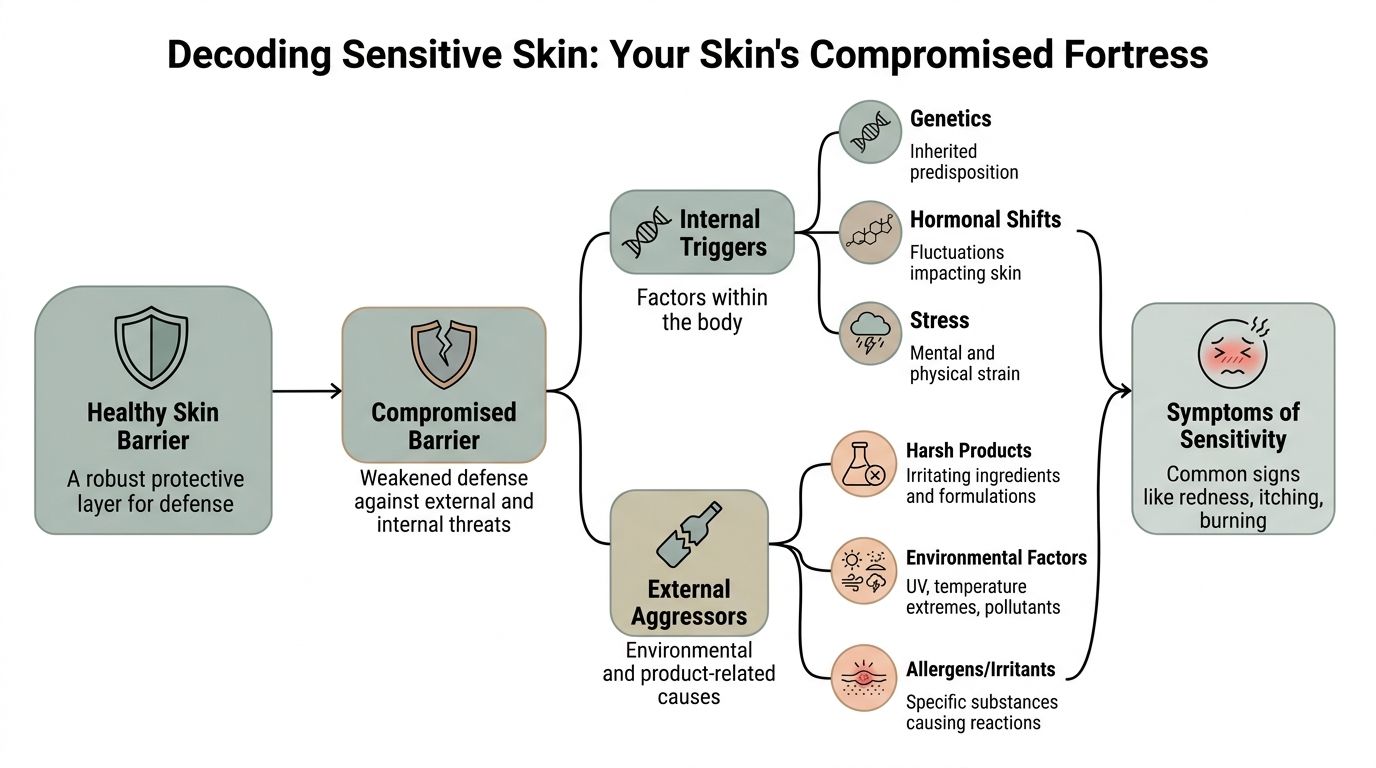
What a weakened barrier feels like
Visible redness is only one clue.
In practice, the earliest signs are often sensory. Skin starts objecting before it starts announcing itself in the mirror.
Common signs include:
Stinging: Often shows up after cleansing, vitamin C, retinoids, or even plain moisturizer
Burning: Heat that lingers longer than it should after product application
Itching: A restless, unsettled feeling, often paired with dryness
Tightness: Skin feels thin, papery, or uncomfortable after washing
Sudden intolerance: Products that used to feel fine now seem irritating
These reactions usually point to the same problem. Water is escaping too easily, and outside triggers are getting in too easily. The face tends to react first because it faces constant exposure to sun, wind, temperature shifts, and repeated product contact.
Why some faces react more intensely
Not all sensitive skin behaves the same way. Some clients flush with heat. Others sting from nearly everything yet show very little redness. Some react after overusing acids. Others have always had a lower threshold.
Part of that difference comes from biology. Some skin has a naturally lower tolerance, a thinner or less resilient barrier, or a stronger nerve response to friction, temperature, and topical products. In the treatment room, that distinction matters. Skin that is highly reactive on a sensory level may need a very gentle approach even when it does not look severely inflamed.
That is one of the foundations of a tranquil treatment plan. We do not judge sensitivity by appearance alone. We judge it by behavior.
Triggers that push skin past its limit
Reactive skin usually develops from accumulation, not a single dramatic mistake. A new serum may be the final straw, but it is often sitting on top of stress, weather exposure, over-cleansing, poor sleep, aggressive treatments, or hormonal change.
I see these patterns often:
Internal influences
Genetic tendency: Some people are born with a lower irritation threshold
Hormonal shifts: Changes in hormones can affect oil production, inflammation, and skin comfort
Stress: The skin often becomes more reactive during emotionally or physically stressful periods
External influences
Harsh products: Scrubs, strong acids, retinoid overuse, and fragrance-heavy formulas can erode tolerance
Climate stress: Heat, wind, sun, dry air, humidity, and abrupt temperature changes can trigger flushing or dehydration
Over-treatment: Too many active products, frequent exfoliation, and repeated experimentation keep the skin in a state of recovery
Friction: Washcloths, cleansing brushes, vigorous massage, and even frequent face touching can keep irritation going
Sensitive skin is not weak. It is over-alert.
That distinction changes how a client chooses a facial. The goal is not to train the skin to endure more stimulation. The goal is to lower the daily burden on the barrier so the skin can return to a steadier, more comfortable state. Once you understand that principle, you can evaluate any treatment through a calmer, more intelligent lens.
The Pillars of a Restorative Facial
The method matters as much as the mask. A treatment can feature lovely ingredients and still overwhelm reactive skin if the hands are too aggressive, the room is too warm, the steam is too intense, or the provider follows a rigid protocol instead of reading the face in front of them.
The best facial for sensitive skin rests on a framework of tranquility. It is a sequence built around respect.
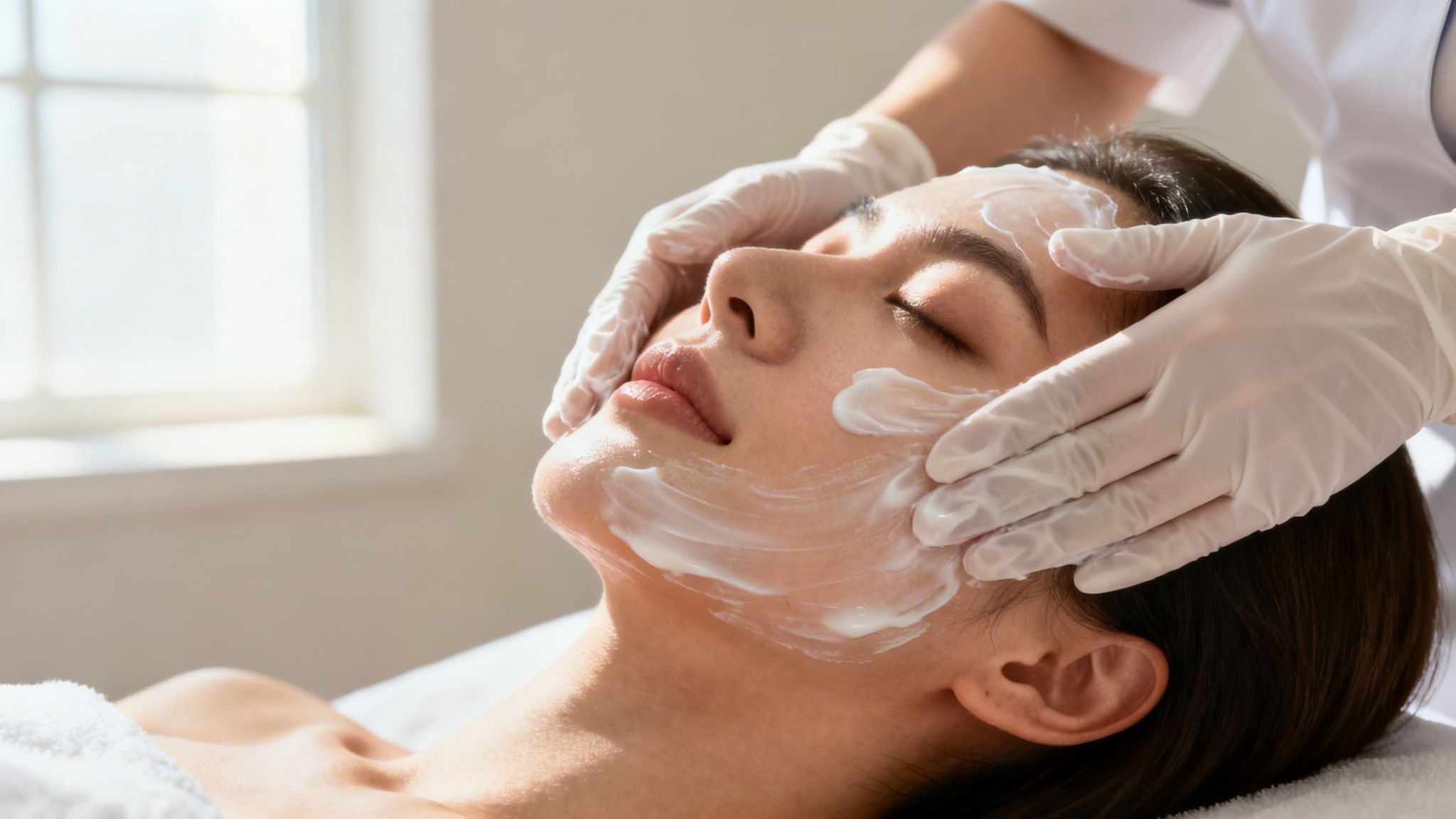
Consultation is part of the treatment
A rushed intake is one of the clearest red flags in sensitive-skin care. Before a single product touches the face, the provider should understand recent reactions, current actives, medication use, heat sensitivity, known triggers, and whether the skin is presently calm or already inflamed.
This conversation shapes every choice that follows.
A thoughtful consultation may change:
cleanser texture
water temperature
whether exfoliation happens at all
mask timing
massage pressure
whether extractions should be skipped
Reactive skin does not benefit from a pre-set script. It benefits from editing.
Touch should feel intelligent, not impressive
There is a persistent myth that a “results-driven” facial must be vigorous. For sensitive skin, that is often the opposite of skilled care. Heavy kneading, prolonged friction, and repetitive rubbing can leave the barrier more fragile than when the appointment began.
A better approach uses measured, soothing contact. Think slow cleansing, light lymphatic-style movements, pauses between steps, and enough slip that the skin is never tugged.
A refined facial massage for reactive skin should encourage circulation without creating heat. It should settle the face, not stir it up.
Temperature control is a luxury standard
Heat is one of the most overlooked triggers in facials. Very warm steam, hot towels, overheated rooms, and sudden temperature shifts can all provoke flushing.
For sensitive skin, comfort usually comes from moderation:
Lukewarm cleansing: Never hot.
Soft steam or no steam: Depending on the client’s tolerance.
Cooler finishing steps: To help the skin feel contained and composed.
The skin should never feel as if it is being pushed open.
Extractions require discipline
Many clients with reactive skin fear extractions because they associate them with pressure, soreness, and days of lingering redness. That concern is justified when extractions are treated as a performance.
In a restorative facial, extractions are minimal, selective, and never forced. If congestion is not ready to release easily, it is often wiser to soften and revisit another time than to wage war on the pores.
What to look for in the treatment room
A sensitive-skin-safe facial usually includes these signs:
A slower pace: The provider is not rushing from step to step.
Product restraint: Fewer formulas, chosen carefully.
Real-time adjustment: Redness is treated as feedback.
A calm finish: Skin leaves hydrated and settled, not shiny and inflamed.
What should make you cautious
Be wary if a menu or consultation leans heavily on the following for reactive skin:
Strong scrubs
High-heat steam
Lengthy extractions
Multiple active layers
A one-size-fits-all promise
In sensitive-skin care, restraint is not a lesser service. It is often the most refined one.
A Curated Apothecary Safe Ingredients for Reactive Skin
Sensitive skin often responds best to an edited formula. In the treatment room, I look for products that do a few jobs well, rinse cleanly, and leave the skin quieter than I found it.
Clinical guidance for reactive skin favors simpler, lower-risk product profiles, including mild cleansers, water-removable formulas, and physical sunscreen filters. The same review noted good tolerance for mild syndet cleansers among patients with acne and rosacea. Those details matter because sensitive skin usually fares better with compatibility than intensity.
Ingredient choice shapes the entire facial. A well-chosen serum can reduce tightness within minutes. A poorly chosen fragrance blend can leave the skin warm and unsettled for hours.
Sensitive Skin Ingredient Guide Sanctuary vs. Stressors
Sanctuary Ingredients (Look For) | Stressor Ingredients (Avoid) |
|---|---|
Hyaluronic acid | Synthetic fragrance |
Glycerin | Dye-heavy formulas |
Squalane | Harsh sulfates |
Colloidal oatmeal | Drying alcohol-heavy formulas |
Aloe vera | Aggressive scrubs |
Chamomile | Strong exfoliating acid blends |
Cucumber | Highly complicated formulas with many potential triggers |
Niacinamide | Products that leave persistent tingling or heat |
Why the sanctuary side works
Reactive skin needs water, cushioning, and fewer interruptions to its barrier.
Humectants that cushion
Hyaluronic acid and glycerin help bind water in the upper layers of the skin, which can ease that taut, papery feeling many sensitive clients describe after cleansing. In a facial, I prefer them in fluid layers, gel masks, or light finishing serums that hydrate thoroughly without creating heat or heaviness.
Lipid-friendly support
Squalane supports comfort beautifully because it softens roughness and seals in moisture with a refined skin feel. It suits clients who want relief from dryness but dislike rich occlusive creams.
Botanical calmers
Chamomile, aloe vera, and cucumber remain useful when the formula around them is equally gentle. They are most helpful in compresses, masks, and cooling gels designed to settle visible agitation rather than stimulate the skin.
Multi-tasking reassurance
Niacinamide can be an excellent ingredient for reactive complexions, especially when redness and barrier weakness show up together. The trade-off is concentration. Lower, well-formulated percentages are often better tolerated than aggressive treatment serums.
Why the stressor side causes trouble
Irritation is often cumulative. One fragranced cleanser, one acid toner, one scrub, and one active mask may each seem manageable on their own. Layered together, they can leave sensitive skin flushed, dehydrated, and unpredictable.
A few repeat offenders show up often:
Synthetic fragrance: A common trigger in skin that stings or reddens easily.
Harsh sulfates: These can strip the skin and create that squeaky-clean feeling that usually signals barrier disruption.
Drying alcohol-heavy formulas: They evaporate quickly and often leave behind tightness.
Aggressive acids and scrubs: Useful for some skin types, but reactive skin usually needs more spacing, lower strength, or a different approach altogether.
Treatment names can also confuse clients. A service such as HydraFacial may be adapted gently for some sensitive clients, but the safety lies in the specific tips, solutions, suction settings, and provider restraint, not in the brand name alone.
That is the framework of tranquility in practice. Judge a facial by how carefully the ingredients are chosen, how few unnecessary triggers are introduced, and how calm your skin looks afterward. For home care, this guide to complexion and skin care can help you apply the same standards between appointments.
A refined routine is usually shorter than expected. Gentle cleanse. Deep hydration. Reliable protection. Consistency.
Exploring the Best Calming Facial Treatments
When clients ask for the best facial for sensitive skin, they are often really asking a more personal question: Which treatment will calm my particular kind of reactivity without leaving me worse off tomorrow?
The answer depends on whether your skin leans dry, flushed, congested, dull, or overworked. Certain facial types stand out because they deliver comfort and visible improvement without relying on abrasion.
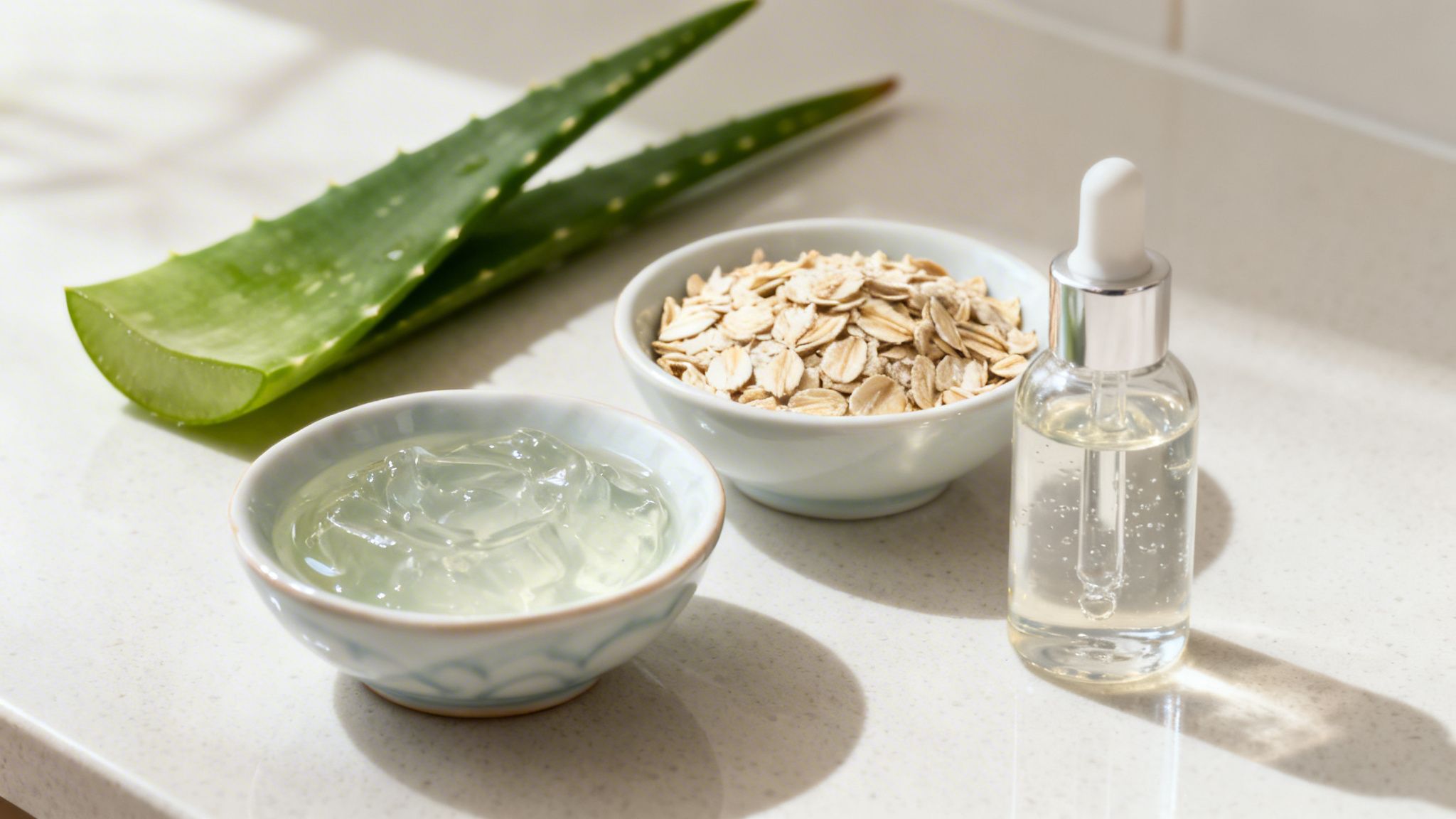
Hydrating hyaluronic facial
This is often the safest first choice for skin that feels thin, thirsty, or easily flushed after cleansing.
The experience should feel cocooning. The skin is cleansed without foam overload, layered with water-binding hydration, and sealed with a mask or finishing serum that reduces that dry, stretched sensation many reactive clients know well.
This style of facial is especially useful when:
Tightness is your main complaint
Flaking appears without true oiliness
Your skin reacts because it is depleted, not congested
A good hydrating facial leaves the face feeling supple and rested. Not slick. Not overworked.
Calming chamomile and aloe facial
For visible redness, recent irritation, or skin that seems emotionally reactive to everything, a calming facial is often the most elegant option.
Chamomile, aloe vera, and cucumber are frequently used in these treatments because they create a more settled canvas. The best versions avoid over-massage and instead focus on cool compresses, creamy textures, and supportive barrier layers.
This facial suits clients who say:
“My skin gets red from almost anything.”
“I do not want exfoliation today.”
“I want relief more than glow.”
Oxygen facial
An oxygen facial can be an excellent compromise for clients who want brightness but cannot tolerate the drama of stronger resurfacing treatments.
It is often chosen when skin looks fatigued or dull yet still needs a gentle approach. The sensation tends to be fresh, light, and clean rather than tingly or hot. It can create a more awake complexion without the sharpness of a peel.
This is one reason oxygen-based treatments remain appealing in luxury settings. They offer a polished finish while keeping the experience soft.
A curated menu of facials is most useful when it allows this kind of customization rather than assuming every sensitive complexion needs the same recipe.
Pomegranate enzyme facial
Clients often hear “enzyme” and worry it means intensity. A gentle enzyme facial can be quite different from a strong acid experience.
Pomegranate enzyme treatments are valued for offering a softer form of exfoliation. Instead of relying on a gritty scrub or a highly active peel, they aim to loosen dull surface buildup in a more refined way. That makes them a strong option for sensitive skin that looks uneven or tired but still needs a guarded hand.
The key is moderation. Enzyme use for reactive skin should be brief, carefully monitored, and paired with replenishing steps immediately after.
Where a HydraFacial may fit
Some clients want both purification and hydration, especially if they have sensitive skin with congestion around the nose or chin. In those cases, a carefully chosen HydraFacial can be worth understanding because it is often discussed as a gentler alternative to harsher extraction-focused treatments. The value lies in how it combines cleansing and infusion in a more controlled format.
That said, not every sensitive client needs it, and not every version is equally appropriate. Settings, boosters, and the provider’s judgment matter.
Later in the treatment selection process, it helps to see a facial in motion and notice how pace and technique shape the experience.
How to choose among them
A simple way to match treatment to concern:
Concern | Best fit |
|---|---|
Dryness and tightness | Hydrating hyaluronic facial |
Redness and recent irritation | Calming chamomile and aloe facial |
Dullness without peel tolerance | Oxygen facial |
Rough texture with caution | Gentle pomegranate enzyme facial |
The best facial for sensitive skin is often the one that addresses your main concern while leaving the fewest opportunities for the skin to protest.
Elevating Your Facial with Gentle Technologies
Technology earns its place in a sensitive-skin facial only when it preserves quiet in the skin.
That is the framework I use in the treatment room. Any device should lower the chance of friction, excess heat, aggressive suction, or prolonged stimulation. If it cannot do that, it does not belong in a restorative protocol, no matter how popular it is.
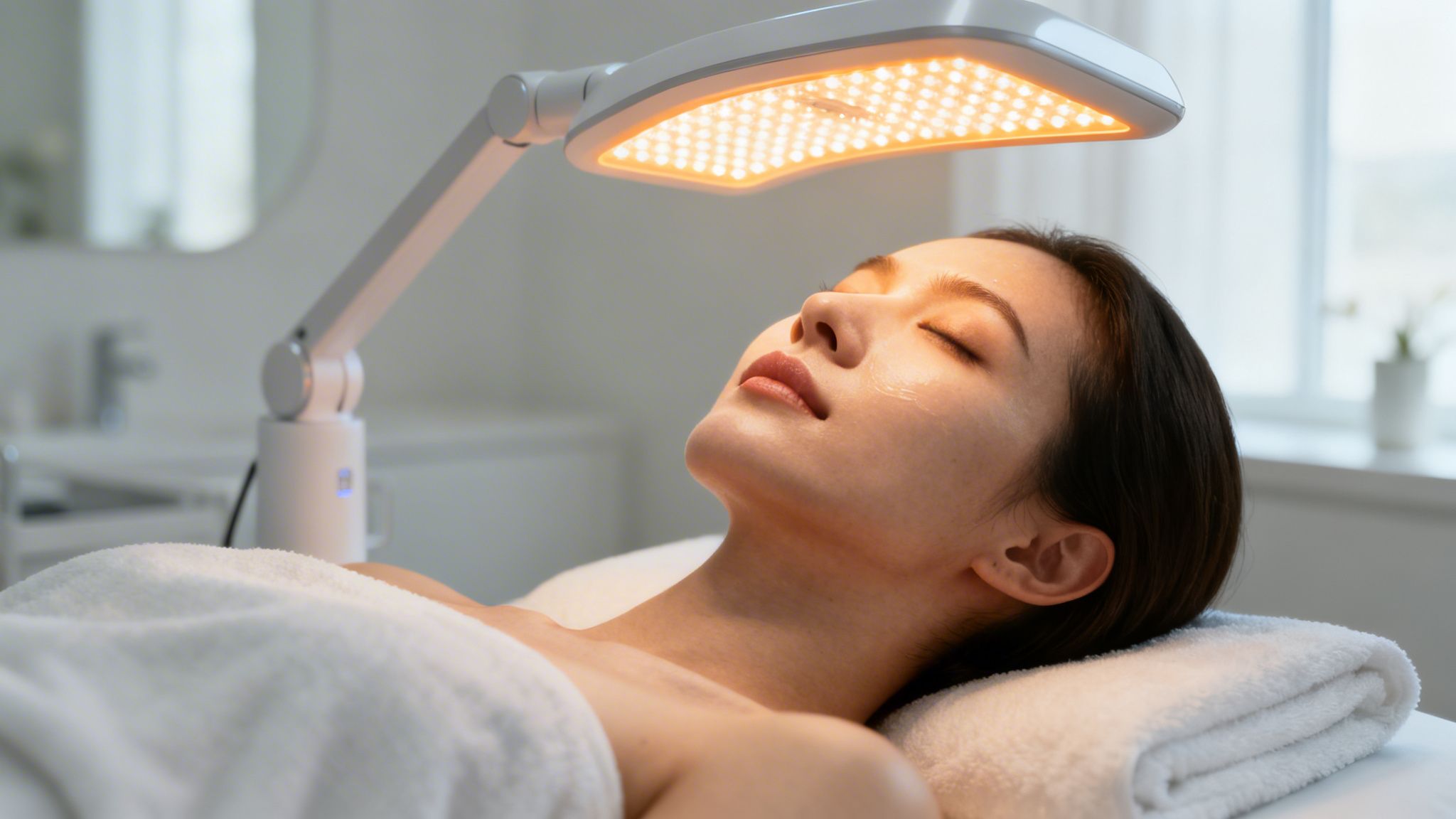
Red LED for visible calm
Red LED is one of the few technologies that many reactive clients tolerate well because it is passive, quiet, and does not require abrasion. In practice, I reserve it for skin that needs support rather than correction at all costs. The goal is comfort, less visible redness, and a treatment experience that does not leave the face feeling worked over.
Wavelengths in the red range, often around 630 to 660 nm, are commonly used in aesthetic settings. Session length and frequency vary by device and by the client’s level of reactivity, which is why exact protocols should come from the treating professional and the device manufacturer rather than a generic promise online.
For the client, the appeal is straightforward. You rest under the light. There is no scrubbing, no pulling, and for many, no recovery period. That makes it a thoughtful addition when the skin is already asking for less.
If you are curious about the equipment category itself, this overview of LED Lamp Therapy offers helpful context on how the modality is used in aesthetic settings.
Vortex-based cleansing and infusion
The second category worth considering is controlled vortex-based cleansing and serum infusion. This can suit a sensitive client who wants help with congestion but does not respond well to traditional manual extractions.
The trade-off matters here. A machine-assisted cleansing treatment can feel gentler than forceful pore work, but only if the settings are conservative, the passes are limited, and the chosen solutions are appropriate for reactive skin. Strong acids, too many passes, or unnecessary suction can still leave the skin flushed and unsettled.
In a well-judged facial, this technology is used selectively. The provider may focus only on congested areas, avoid inflamed zones entirely, and follow immediately with barrier-replenishing support. That restraint is often what separates a soothing advanced facial from one that does too much.
Where technology belongs in a luxury facial
Devices should refine a facial, not run it.
Sensitive skin responds best when technology is placed inside a calm sequence with a clear purpose:
Assessment first: Check for current irritation, recent exfoliation, medication use, and areas that should be avoided
Selective use of technology: Choose one supportive modality based on the skin in front of you
Barrier-focused finishing care: Use replenishing serums and creams that reduce the chance of post-treatment tightness
Response-based planning: Let the skin’s recovery determine whether that technology should be repeated, adjusted, or skipped next time
Clients who hold fluid easily or wake with facial puffiness often benefit from modalities centered on gentle movement rather than intensity, which is why lymph drainage enhancement often pairs beautifully with restorative facial care.
The best technology for sensitive skin is the one that supports balance without asking the barrier to defend itself.
Your Naples Sanctuary The Unwind Head Spa Experience
For residents of Naples and Collier County, the most comforting facial experience is rarely the flashiest one on the menu. It is the one that feels thoroughly considered from the first welcome to the final press of serum into the skin.
That means a quiet environment. Clear communication. A provider who notices subtle signs of overstimulation before they become obvious. It also means understanding that sensitive skin often arrives with another burden: exhaustion. Many clients are not only managing redness or dryness. They are carrying stress, poor sleep, overexposure to the elements, and the fatigue of trying too many things.
In that setting, the best facial for sensitive skin should feel restorative in the fullest sense. It should calm the complexion and soften the mind.
What refined care looks like
A facial in Naples should respect local living conditions. Sun exposure, heat, humidity, and daily environmental stress can all influence how the face behaves. Skin may feel both reactive and dehydrated. It may flush easily yet still need purification. It may crave results while tolerating very little force.
That is why elevated care depends on three qualities.
Precision
Reactive skin needs a practitioner who can edit in real time. One client may benefit from a highly hydrating treatment with almost no exfoliation. Another may need gentle enzyme work followed by calming support. Precision is the difference between a facial that feels bespoke and one that feels risky.
Product integrity
Organic, luxurious products can be a beautiful fit for sensitive skin when they are chosen for compatibility rather than novelty. Texture matters. Finish matters. Ingredient clarity matters.
Atmosphere
The setting shapes outcomes more than many people realize. A calm, immaculate, welcoming room changes how a client receives touch, breathes through the appointment, and leaves the experience. Sensitive skin often improves when the entire ritual communicates safety.
Why this matters locally
Naples clients often want both performance and serenity. They are not looking for a punishing treatment followed by a week of recovery. They want their skin to look polished for dinner, events, work, and everyday life, while still feeling like itself.
That is the standard worth holding.
The right practitioner does not try to impress sensitive skin. She listens to it. She works with measured hands, intelligent pacing, and formulas that support balance. Over time, that approach often creates the most elegant result of all: skin that appears more comfortable in its own surface.
If you are ready for a more thoughtful approach to facial care, Unwind Head Spa offers Naples clients a serene setting, customized treatments, and the seasoned touch of an aesthetic professional with 25+ years of experience. Using luxurious organic lines from Arete and Oway, each session is designed to restore balance gently and beautifully for skin, scalp, and state of mind.