↓ Scroll ↓
Apr 22, 2026
Discover how to reduce stress and anxiety with practical tips and luxury wellness rituals. A guide for Naples residents seeking calm and restoration.

Some days in Naples look beautiful from the outside and feel strained from the inside. Your calendar is full, your phone keeps vibrating, your shoulders are tight before noon, and by evening you’re too drained to enjoy the life you work so hard to create. Stress often hides under polished routines.
That’s why learning how to reduce stress and anxiety has to go beyond generic advice. A refined wellness routine isn’t only about doing more. It’s about choosing the right forms of relief, at the right time, in the right sequence. Immediate regulation matters. Daily habits matter. Mental tools matter. So does embodied restoration.
Embracing Calm in the Midst of Modern Life
A high-functioning life can still be an overstimulated one. Many people move through the day appearing composed while carrying internal pressure that shows up as shallow breathing, jaw tension, racing thoughts, irritability, or a persistent sense that rest never quite lands. That experience is common, and it deserves to be addressed with intelligence rather than shame.
The global picture makes that clear. According to the World Health Organization, anxiety disorders are the world’s most common mental disorder, affecting 359 million people globally in 2021, and only approximately 1 in 4 people in need of care receive any treatment according to the World Health Organization anxiety disorders fact sheet. Stress and anxiety aren’t signs that you’re failing at life. They’re health concerns that require skillful care.
A wellness ecosystem works better than a single fix
A single tactic rarely resolves a chronically overloaded nervous system. Breathing can help in the moment. Better sleep can improve your threshold. Cognitive tools can reduce spiraling. Therapeutic touch can release physical holding patterns your mind may not even notice.
That layered approach matters because stress tends to arrive in layers too.
Physical strain often shows up first as tight muscles, headaches, scalp tension, digestive discomfort, or restless sleep.
Mental overload creates looping thoughts, catastrophic thinking, difficulty focusing, and an inability to switch off.
Emotional fatigue can feel like irritability, numbness, or a short fuse with people you care about.
A calm life isn’t built from one perfect habit. It’s built from a set of practices that support each other.
Luxury wellness, at its best, isn’t indulgence for its own sake. It is intentional environment, sensory regulation, and skilled care that helps the body feel safe enough to soften. That is often the missing piece for people who already know what they “should” do, yet still feel wired.
Immediate Relief Techniques for Overwhelming Moments
When stress spikes, don’t start by trying to reason your way out of it. Start by giving your body a clear signal that the threat level has changed. Acute anxiety responds better to simple somatic actions than to complicated self-talk.
Use breath to interrupt escalation
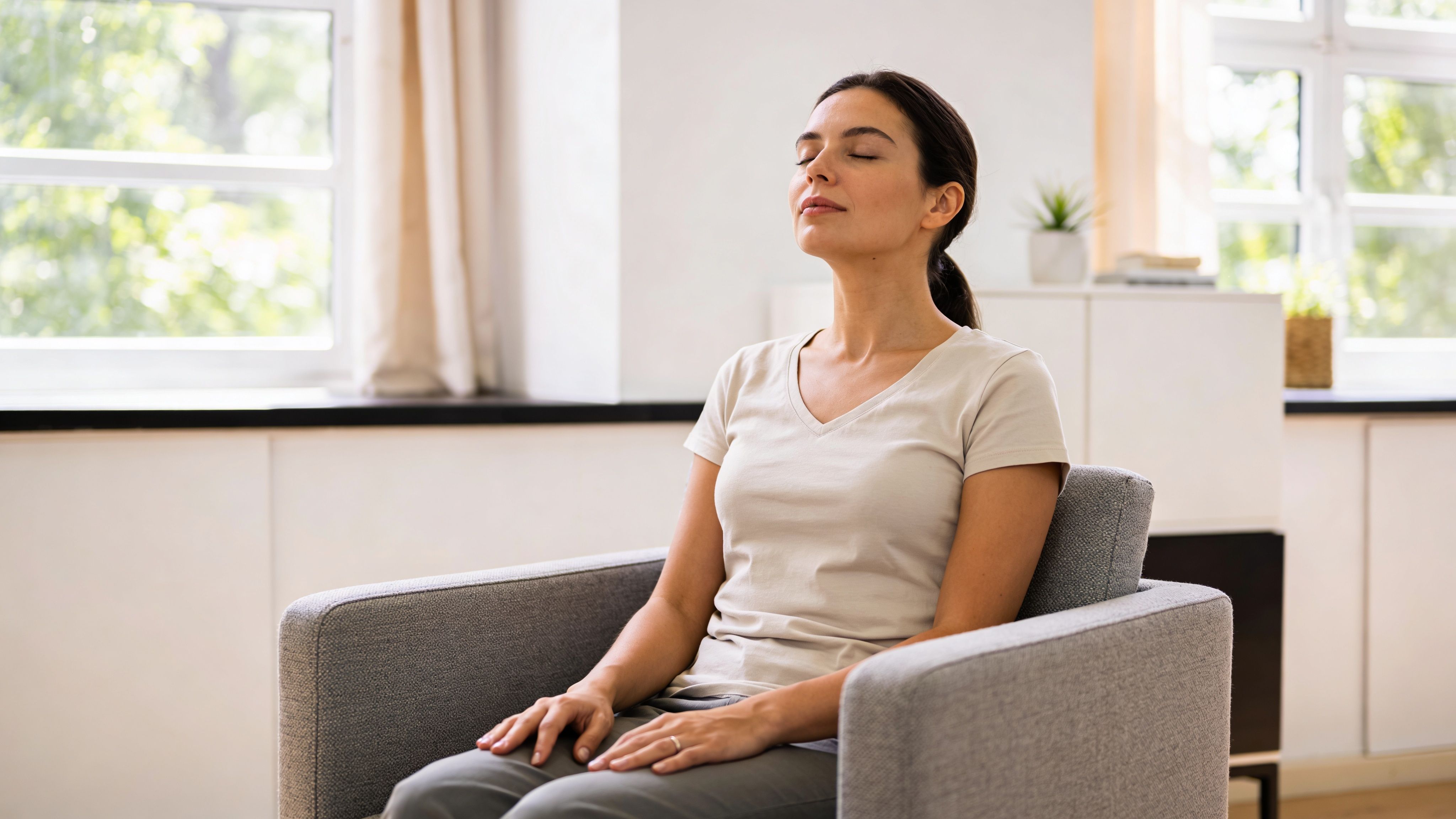
Box breathing is useful because it gives the mind a structure to follow while slowing the body’s stress response.
Inhale through the nose for a slow count of four.
Hold for four.
Exhale for four.
Hold again for four.
Repeat for several rounds. If a count of four feels too long, shorten it. The point isn’t performance. The point is rhythm.
This works well before a meeting, while sitting in your car, or during that sharp moment when your chest feels tight and your thoughts start running ahead of you.
Ground the mind through the senses
When anxiety makes you feel detached or mentally flooded, use the 5-4-3-2-1 grounding method. It’s discreet, effective, and elegant in its simplicity.
5 things you can see. Name details, not categories.
4 things you can feel. The chair beneath you, fabric on your skin, air on your arms.
3 things you can hear. Distant voices, the hum of air conditioning, birds outside.
2 things you can smell.
1 thing you can taste.
This method works because it redirects attention from imagined threats to present sensory reality.
Practical rule: If your thoughts are spiraling, move attention out of the story and into the body.
Release tension where stress actually lives
Stress rarely stays in the mind alone. It settles into the jaw, neck, temples, and scalp. During the day, place your fingertips at the base of your skull and gently press in small circles. Then unclench your tongue from the roof of your mouth and soften the space between your brows.
A few minutes of targeted touch can shift your state faster than endlessly checking your phone for reassurance. For a deeper version of that approach, this guide on head massage for stress relief explains why localized relaxation can be so effective.
A short guided practice can help if you prefer to regulate with visual cues:
What doesn’t work in the moment
Certain habits feel soothing but usually worsen the cycle.
Habit | Why it backfires |
|---|---|
Doom scrolling | It adds stimulation when your system already feels overloaded |
Pushing through without pause | It often intensifies physical tension and mental fragmentation |
Overexplaining your anxiety to yourself | It can turn a passing wave into a prolonged mental loop |
The most effective immediate tools are brief, repeatable, and body-based. They don’t ask you to become a different person in a crisis. They help you return to yourself quickly.
Cultivating Daily Rituals for Lasting Serenity
Acute relief is important, but resilience is built earlier. The nervous system responds well to predictable signals of safety. That’s why daily rituals matter more than occasional heroic efforts.
Recent research supports that approach. Evidence-based mind-body interventions and physical activity represent significant non-pharmacological approaches. A 2023 trial found mindfulness-based stress reduction noninferior to a common prescription drug for anxiety, and exercise training is shown to reduce symptoms in anxiety and stress-related disorders according to the NCCIH summary on mind and body approaches for stress.
Move in ways that settle rather than punish
Movement helps most when it doesn’t feel like another obligation. A brisk walk, gentle strength work, mat Pilates, swimming, or slow mobility work can all support emotional steadiness. What matters is consistency and the quality of attention you bring to it.
Try this shift in mindset:
Don’t ask whether the workout was impressive.
Ask whether your body feels clearer afterward.
Notice whether your breathing deepens and your mind stops rushing.
That is often a better marker for stress care than intensity.
Turn nourishment into a calming ritual
Stress often makes people either skip meals or eat while distracted. Both can leave the body feeling more unsettled. A simple practice is to create one deliberate pause each day around a warm drink or quiet meal with no multitasking.
For readers who enjoy a sensory wind-down ritual, this guide to tea that relaxes body and mind offers useful ideas for choosing blends that suit a slower evening rhythm.
A ritual only works if it lowers friction. Make it easy enough to repeat on your busiest day.
Protect sleep like a wellness treatment
Among lifestyle factors that affect mental health, stress and sleep stand out prominently in the verified research. In practice, poor sleep tends to make everything feel louder. People become more reactive, less patient, and more vulnerable to anxious interpretation.
A more polished evening routine usually includes:
A clear ending to work rather than carrying tasks into bed
Lower sensory input in the final stretch of the evening
Warm water or herbal tea as a cue that the day is closing
Dimmer light and quieter conversation instead of stimulating media
If your evenings tend to blur into one long extension of the workday, these ideas on how to relax after work can help you create a gentler transition.
Small rituals outperform dramatic resets
People often think stress reduction requires a retreat, a perfect morning routine, or an entirely new schedule. Usually it doesn’t. It requires repetition.
Three calm moments practiced consistently often do more than one ambitious overhaul that disappears after a week. The body trusts what it experiences regularly.
The Art of a Balanced Mind Cognitive Tools for Resilience
Stress isn’t only about what happens around you. It’s also about the interpretations that gain momentum inside you. A balanced mind doesn’t mean a mind with no negative thoughts. It means a mind that can notice a thought, question it, and choose a steadier response.
Principles from Cognitive Behavioral Therapy, or CBT, are particularly useful. CBT demonstrates approximately 51% remission rates for anxiety disorder patients, with success rates for Social Anxiety Disorder exceeding 70%. Even a practical 6-session protocol can produce statistically significant reductions in anxiety sensitivity according to this review of CBT success rates for anxiety therapy.
Reframing is mental decluttering
A reframed thought is not a fake positive thought. It is a more accurate one.
Suppose your mind says, “If I don’t handle this perfectly, everything will fall apart.” A more balanced replacement might be, “This matters, but it doesn’t require perfection. I can handle the next step.”
That shift reduces the pressure load immediately.
Here’s a useful comparison:
Stress thought | Reframed thought |
|---|---|
I’m behind and I’ll never catch up | I’m overloaded today. I can still prioritize one thing at a time |
They’ll think I’m not capable | I may feel anxious, but anxiety isn’t proof of incompetence |
I have to solve all of this now | I only need to decide what requires attention today |
Contain worry instead of feeding it all day
Worry scheduling sounds simple, but it can be remarkably effective. Set aside a short, consistent block of time each day for anxious thinking. When worries intrude outside that window, write them down and postpone them.
This works because the brain learns that it doesn’t need to raise the same alert every hour. You’re not suppressing concern. You’re giving it boundaries.
Try this structure:
Choose a daily window in the late afternoon, not right before bed.
Keep a note nearby and capture intrusive thoughts briefly.
Review the list during the scheduled time.
Sort worries into action items, waiting items, and thoughts that don’t need further airtime.
A thought can be loud without being wise.
Know when self-help isn’t enough
There’s a point where stress shifts from manageable strain to something that deserves professional support. If anxiety keeps disrupting sleep, concentration, relationships, or your ability to function, it’s time to bring in a trained clinician.
That isn’t a last resort. It’s a strong decision.
CBT is especially valuable for people who appreciate structure. It gives language to thought patterns, offers specific practices between sessions, and helps many people replace internal chaos with clearer mental habits. True wellness should always leave room for clinical care when it’s needed.
The Ultimate Restoration The Role of Therapeutic Rituals
Many stress-management conversations focus on meditation, movement, and mindset. All of those matter. But one physical area is often overlooked even though people hold tension there constantly. The scalp.
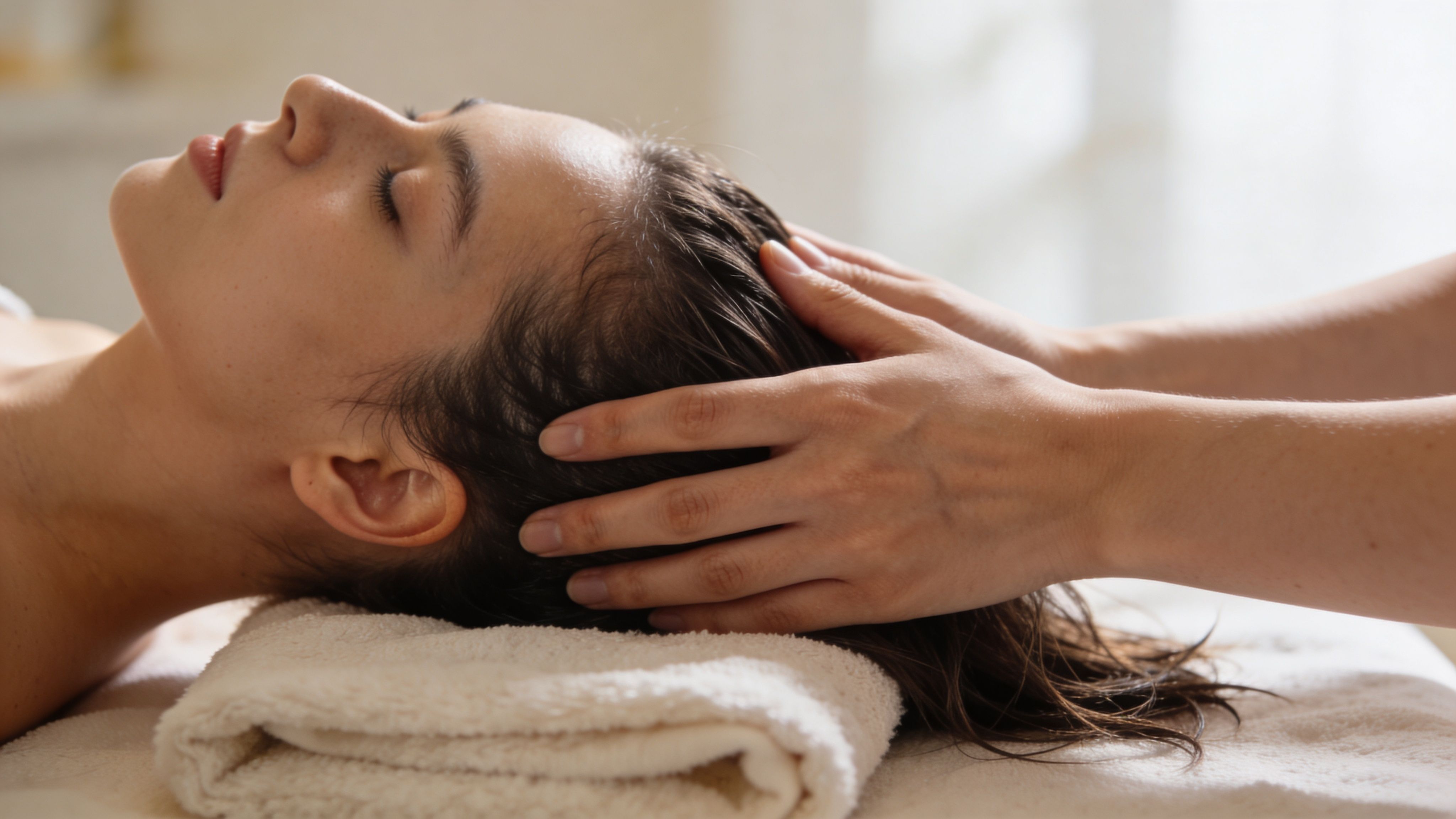
The scalp contains numerous nerve endings and is a primary site where people unconsciously hold tension during stress, making it a logical but overlooked entry point for stress relief. A 60-90 minute head spa session combines multiple evidence-backed techniques, tactile relaxation, mindfulness, and parasympathetic activation, in a single, convenient appointment according to this discussion of stress reduction and scalp-focused relaxation.
The scalp is often the missing link
When someone says they feel “tight in the head,” they’re usually describing something real. Scalp tension often travels with jaw clenching, temple pressure, neck stiffness, and mental fatigue. You can meditate faithfully and still carry that physical holding pattern all day.
That’s one reason hands-on therapies can be so powerful. They don’t rely on discipline alone. They help the body experience release directly.
For readers interested in the broader connection between bodywork and emotional ease, this article on how Swedish massage therapy helps reduce anxiety and stress offers helpful context.
Why therapeutic ritual works when generic advice falls flat
A lot of people know the standard list. Breathe more. Sleep more. Exercise more. Those are good recommendations, but they can feel abstract when your nervous system is already saturated.
A therapeutic ritual changes the experience in several ways:
It creates a boundary. You step out of the demand cycle instead of trying to relax while still inside it.
It engages the senses. Warm water, deliberate touch, aroma, and quiet all tell the body it can downshift.
It removes decision fatigue. You don’t have to orchestrate the process yourself.
It localizes relief. Tension in the scalp, neck, and head is addressed directly rather than indirectly.
The body often accepts calm through sensation before the mind accepts it through logic.
A refined option for Naples residents
For busy professionals, caregivers, and people who struggle to sustain at-home routines, a head spa can function as a concentrated reset. At Unwind Head Spa’s Signature Mind Unwind experience, the treatment combines modern scalp care with a quiet, tactile ritual designed to ease physical tension while supporting a calmer internal state. Organic Oway and Arete products add a sensory layer that feels polished rather than overpowering.
That matters because luxury, when used well, isn’t excess. It’s precision. The temperature is considered. The touch is measured. The environment reduces visual and auditory clutter instead of adding more.
What this kind of care does well
This approach is especially useful for people whose stress is embodied. They may not describe themselves as anxious in a formal sense, but they do notice:
Common stress pattern | Why a head-focused ritual can help |
|---|---|
Constant mental chatter | Sensory immersion can redirect attention away from repetitive thought loops |
Jaw, temple, and scalp tightness | Targeted touch addresses the physical site of tension |
Difficulty unplugging | The treatment environment creates a structured pause from stimulation |
Caregiver or professional overload | A scheduled session creates permission to receive care rather than provide it |
A well-rounded wellness routine can include therapy, exercise, breathwork, and sleep support. It can also include treatments that reach the body in ways self-directed practices sometimes can’t.
Your Path to Sustained Tranquility
Stress relief works best when it becomes a practice rather than a rescue mission. In real life, that means having different tools for different moments. You need something for the surge of overwhelm. Something for the ordinary weekday. Something for the recurring thought pattern. Something for the deeper physical holding that doesn’t fully respond to mindset alone.
This provides effective strategies for how to reduce stress and anxiety. Use immediate regulation when your system spikes. Build daily rituals that make calm more familiar. Strengthen your thinking patterns so worry doesn’t dominate the room. Include restorative treatments that allow the body to soften in a more complete way.
Not every method fits every person, and that’s an important trade-off to respect. Some people thrive with structured therapy. Others need movement to discharge stress physically. Some need protected quiet. Many need a combination. What rarely works is waiting until you’re exhausted and then expecting one good night of sleep to undo weeks of accumulation.
Choose practices you’ll actually return to
The most elegant wellness routine is not the most complicated one. It’s the one you can sustain with grace.
Keep one rapid tool for acute stress.
Keep one evening ritual that tells your body the day is over.
Keep one cognitive practice that interrupts spiraling.
Keep one restorative treatment that gives you deeper release.
Calm becomes more available when your routines stop asking for perfection and start offering support.
Peace is not reserved for people with empty schedules. It can be cultivated inside a full life, but it requires deliberate care. If your stress has become physical, mental, and emotional all at once, that’s not a sign to push harder. It’s a sign to create a better structure for recovery.
If you’re ready to make stress relief part of a more intentional wellness rhythm, Unwind Head Spa offers a thoughtful starting point for Naples residents seeking calm, scalp wellness, and restorative care in a serene setting.